When I was asked to work on 'personalization,' I started by asking people around me this question: What makes you you?
When I was asked to work on 'personalization,' I started by asking people around me this question: What makes you you? My fav movie "Little Prince" says "what's important is the unseen." I spent time in conversations, asking what people value about their closest relationships, their creative work, their growth—the places where they feel most like themselves. The answers weren't about algorithms or efficiency. They were about presence, consistency, genuine interest, and the freedom to be imperfect.
Problem
Most personalization work focuses on data—learning preferences, predicting behavior, optimizing for engagement. But that's not what makes something feel personal. What makes something personal is being seen, understood, and respected as a unique individual.
Person & personalization
AI should serve my specific goals and context, not generic templates. It understands what I'm trying to accomplish and adapts to my situation, not the reverse.
Out of those conversations, I've formed my own simplified version of a roadmap for the future of personalization: For Me, With Me, As Me.
Where to NOT use AI
AI should never be a default solution. The "double diamond model" for design thinking is there for a reason.
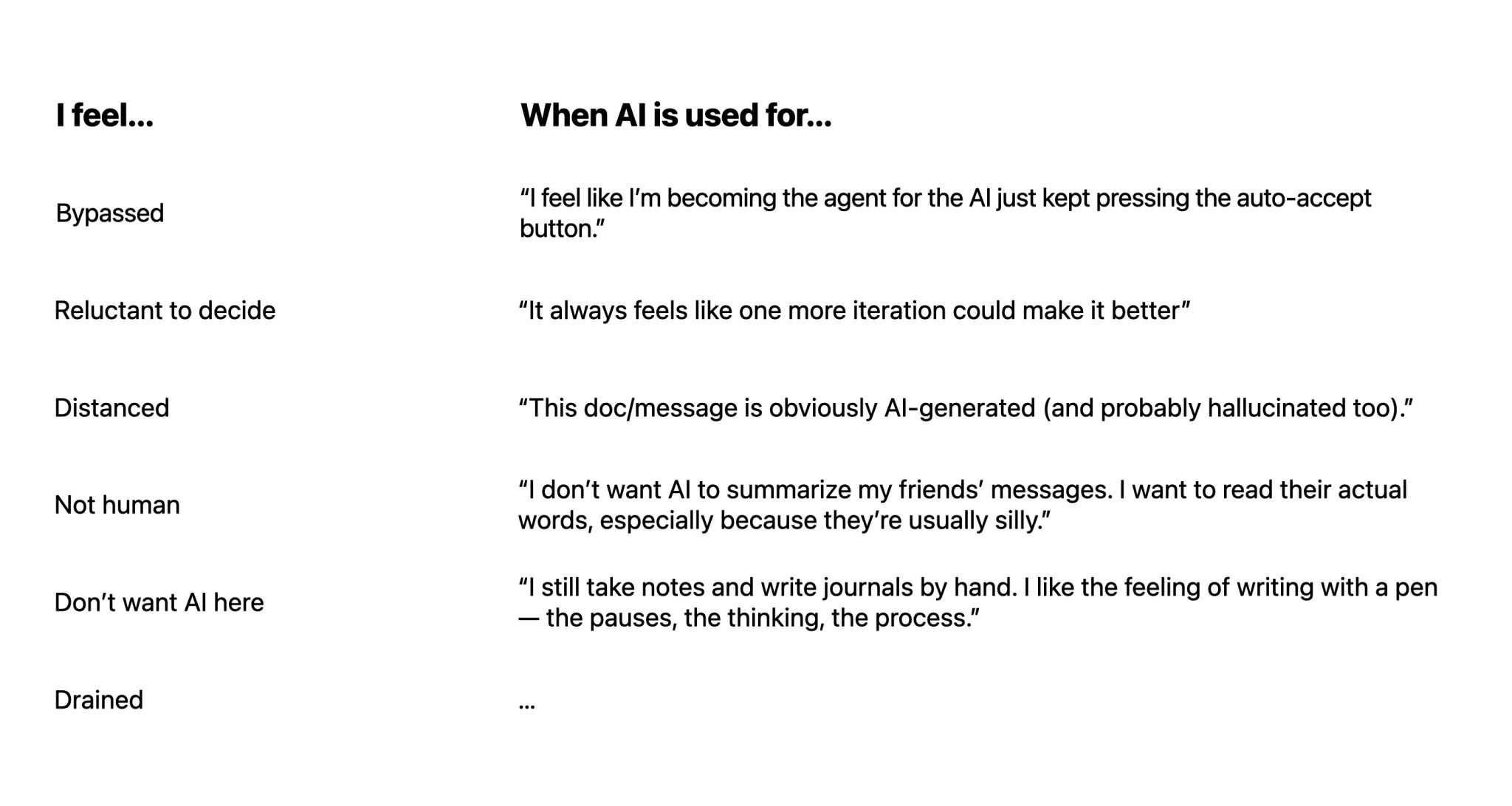
Great AI product design knows its boundaries. It's not about pushing the edges of what's possible—it's about honoring what matters most.
Humanity-centered Design
Yeah, it's a big word... but AI that only understands data will build systems that feel intrusive, prescriptive, or hollow. AI that understands humanity means it knows what we need, how we grow, what we struggle with, and respect our feelings.
The future of AI isn't about knowing everything about you. It's about understanding something essential about what it means to be human, and building systems that respect and support that.